Questions left open
One photo, no scale, no detail. The buyer cannot tell if the vase is 10cm or 40cm tall, so they buy elsewhere.
01Ads and visibility: customers who are looking for your service now or don’t know about it yet.
01 Google AdsEnquiries from people searching for your service right nowfrom £480/mo 02 Social media adsMeta, TikTok, LinkedIn: customers who are not searching yetfrom £480/mo 03 SEOHigher in Google and Maps without paying per clickfrom £430/mo 04 Visibility in ChatGPT and AIYour business in AI assistant answerspart of SEO 05 Amazon, eBay and marketplacesSell where customers already buywith a partnerThe place where a visit turns into an enquiry, and a system that doesn’t lose that enquiry.
01 Web designA website that turns visits into enquirieslanding from £400 02 Online shopsCart, payments and shipping, ready for adsfrom £1,300 03 CRMNo enquiry gets lost in a phonesetup £620 04 Chatbots and AIThey answer customers, at night too£310 05 Email and SMSCustomers come back instead of forgetting youquoted individuallyPlan and tracking first, budget second. You know what works before you spend more.
01 Strategy and auditKnow where to spend the budget before you spend it£500 02 AnalyticsSee which ad brings in money£240 03 ConsultationsA call about your specific problem£25/h 04 Free auditA quick review and 3–5 priorities to start£0How your business looks and sounds before anyone calls you.
01 Social media managementProfiles that look like a real businesswith a partner 02 Creative and videoGraphics and videos that stop the thumbquoted individually 03 BrandingA logo and style that set you apartwith a partner Edmonton, Canada
website with a 3D calculator and a CRM
Boreal Kitchens
 Winnipeg, Canada
website and CRM in one system
Adela Strycharz, REALTOR®
 Żywiec, Poland
500+ page website and CRM for a chain
Gładko Tnący Barber
 Warsaw, Poland
website in 4 languages, calculators and CRM
MagCleaning
Product photography for makers and online shops that cannot justify a studio day. You get a per-product shot list and a home setup built from things you mostly own; I direct over video call if you want, then retouch the results and export sets for your website, ads, Amazon, eBay and Etsy.
Free: a 30-minute call, an action plan and a price range in writing.
One photo, no scale, no detail. The buyer cannot tell if the vase is 10cm or 40cm tall, so they buy elsewhere.
01Each product shot on a different day in a different light. The shop looks like a jumble sale.
02Colours that look different in real life. The customer sends it back, and you pay for both journeys.
03In pounds sterling. Quoted individually on the number of products, shots per product and retouching needed.
Shot lists, setup plan, remote direction, retouching and exports, done by me.
A shop built by me to show those photos properly, with cart, payments and delivery.
E-commerce websites→On the high street, a customer lifts a mug, runs a thumb over the glaze and checks the base for a maker's mark. Online, product photography is the only stand-in for those hands. If the pictures leave someone unsure about size, finish or colour, they hesitate, and hesitation online usually means leaving. If the pictures flatter too much, the parcel comes back.
For small UK online shops and makers, sorting out the photos tends to lift sales and cut returns together, and it usually costs less than any ad campaign.
Shoots go wrong when people improvise. So each item is planned on paper first, usually covering:
Next to each shot sits its destination, since an Amazon hero image and a Stories ad follow completely different rules.
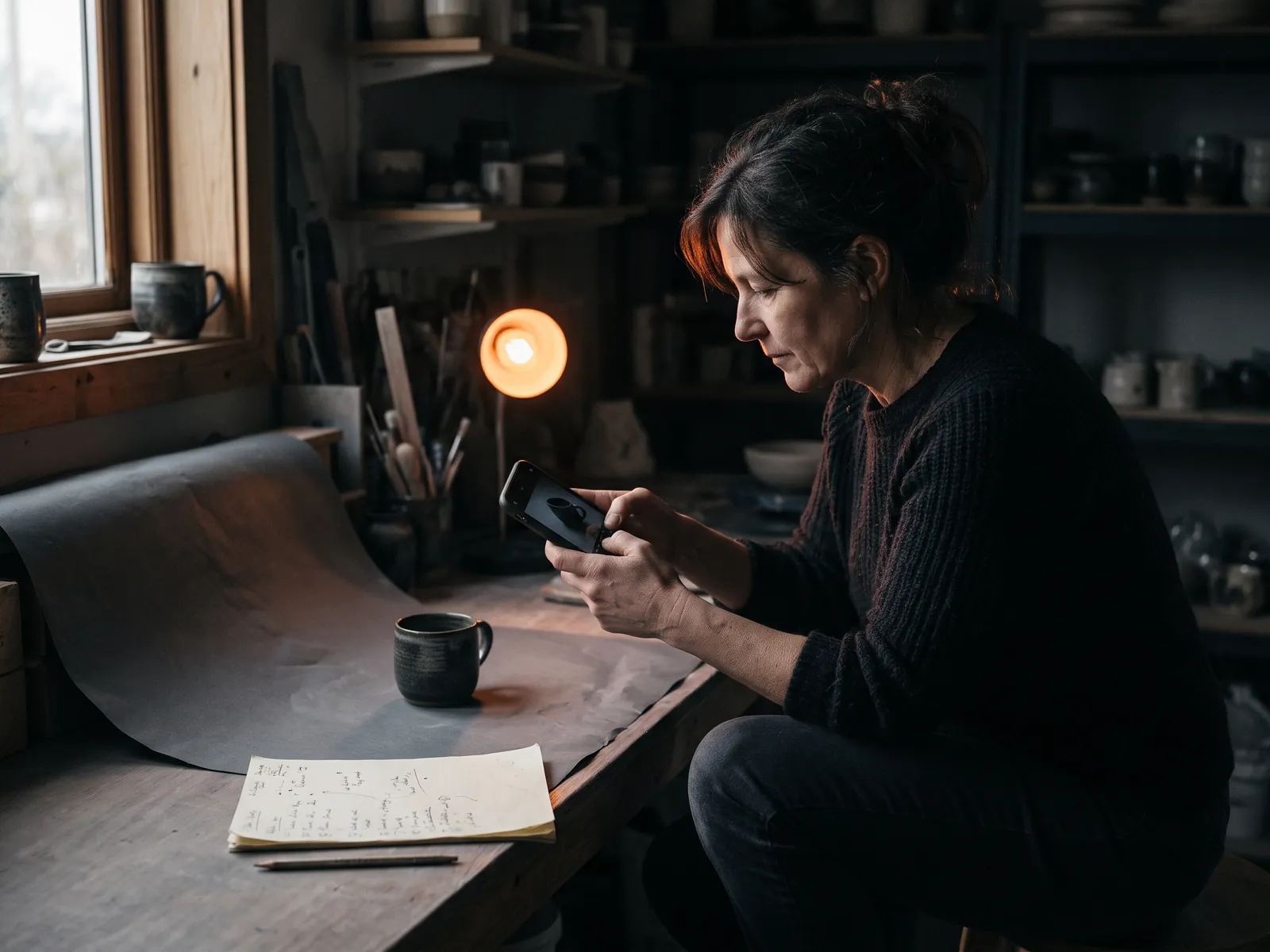
Most small catalogues can be shot at home or in a workshop. Daylight from a side window, a sweep of backdrop paper or a fold-up light box, a sheet of white card to bounce light into shadows, a tripod and whatever phone or camera you have. The setup plan starts from your own kit and adds a brief list of cheap extras only where they make a real difference. Then you send a handful of test shots before the full session. Problems with shadows, reflections or colour casts get fixed on product two, not product sixty.
If you prefer, you can book a local photographer and I write their brief. The retouching and exports still come to me, so the catalogue stays consistent.
Retouching cleans and aligns: dust removed, backgrounds evened out, colours matched to the real product, crops consistent across the range. It does not change what the customer receives. UK consumer law gives online buyers a 14-day cancellation right for most goods, so photos that oversell are paid for twice: once in returns, once in reviews. For beauty and cosmetic products, the ASA has also ruled against ads where filters or editing exaggerate results.
Each sales channel has its own rules. Amazon's main-image rules generally call for the product on plain white. Etsy favours natural, lifestyle-led photos and has its own thumbnail crop. eBay listings benefit from several clear angles. Your own shop needs consistent ratios so the grid looks tidy, and ads need square, 4:5 and vertical crops. I export each set to the right sizes and names, so uploading is quick.
Product photography suits makers, independent brands and small online shops: ceramics, candles, jewellery, clothing, homeware, food and drink, gifts. It works well alongside a new online shop or a marketplace launch on eBay and Etsy. If you are preparing a launch, such as a first collection before Christmas, start early: photos are usually the step that holds everything else up. Allow time for samples to arrive, test shots to be checked and a second session for anything that did not work. A catalogue shot in a rush in late November tends to show it.
New products arrive, seasons change and ranges grow. The setup plan and shot list are written so you can repeat them months later and get matching results: the same distance from the window, the same paper, the same angles in the same order. New photos then sit comfortably next to the old ones, and I can retouch them to the same standard whenever you send a new batch.
For most small products, yes. A big window with indirect daylight, a sheet of white or grey paper curved up a wall, a tripod and a modern phone are enough for clean, consistent shots. Larger items, such as furniture, need more space and sometimes a local photographer, which I can brief.
No. I work remotely, so the shoot happens at your place, done by you or a photographer you book, following my shot list and setup plan. I direct on a video call if you want, check test shots and do all the retouching and exporting afterwards.
Amazon expects the main image to show the product alone on a pure white background, filling most of the frame, with no added text or logos. Other images can show it in use. Requirements change from time to time and vary by category, so I check the current rules before exporting.
When it changes what the buyer gets. Removing dust, fixing a crooked crop and correcting colour are fine. Changing a product's colour, hiding flaws or making it look bigger is misleading, and under UK consumer law and the CAP Code it can lead to complaints, returns and trouble.
Usually five to eight: the hero shot, two or three angles, a close-up, something showing size and a lifestyle picture or two. Simple items need fewer; clothing, jewellery and furniture usually need more, because buyers want to see texture, fit and size before they pay.
Send me a link to your shop or a few current product photos. I will reply within one working day with what I would change first.