Navigation[01]
Lost in
the menu
Services hidden under vague labels like "Solutions", so visitors cannot find the one they came for.
Ads and visibility: customers who are looking for your service now or don’t know about it yet.
01 Google AdsEnquiries from people searching for your service right nowfrom £480/mo 02 Social media adsMeta, TikTok, LinkedIn: customers who are not searching yetfrom £480/mo 03 SEOHigher in Google and Maps without paying per clickfrom £430/mo 04 Visibility in ChatGPT and AIYour business in AI assistant answerspart of SEO 05 Amazon, eBay and marketplacesSell where customers already buywith a partnerThe place where a visit turns into an enquiry, and a system that doesn’t lose that enquiry.
01 Web designA website that turns visits into enquirieslanding from £400 02 Online shopsCart, payments and shipping, ready for adsfrom £1,300 03 CRMNo enquiry gets lost in a phonesetup £620 04 Chatbots and AIThey answer customers, at night too£310 05 Email and SMSCustomers come back instead of forgetting youquoted individuallyPlan and tracking first, budget second. You know what works before you spend more.
01 Strategy and auditKnow where to spend the budget before you spend it£500 02 AnalyticsSee which ad brings in money£240 03 ConsultationsA call about your specific problem£25/h 04 Free auditA quick review and 3–5 priorities to start£0How your business looks and sounds before anyone calls you.
01 Social media managementProfiles that look like a real businesswith a partner 02 Creative and videoGraphics and videos that stop the thumbquoted individually 03 BrandingA logo and style that set you apartwith a partner Edmonton, Canada
website with a 3D calculator and a CRM
Boreal Kitchens
 Winnipeg, Canada
website and CRM in one system
Adela Strycharz, REALTOR®
 Żywiec, Poland
500+ page website and CRM for a chain
Gładko Tnący Barber
 Warsaw, Poland
website in 4 languages, calculators and CRM
MagCleaning
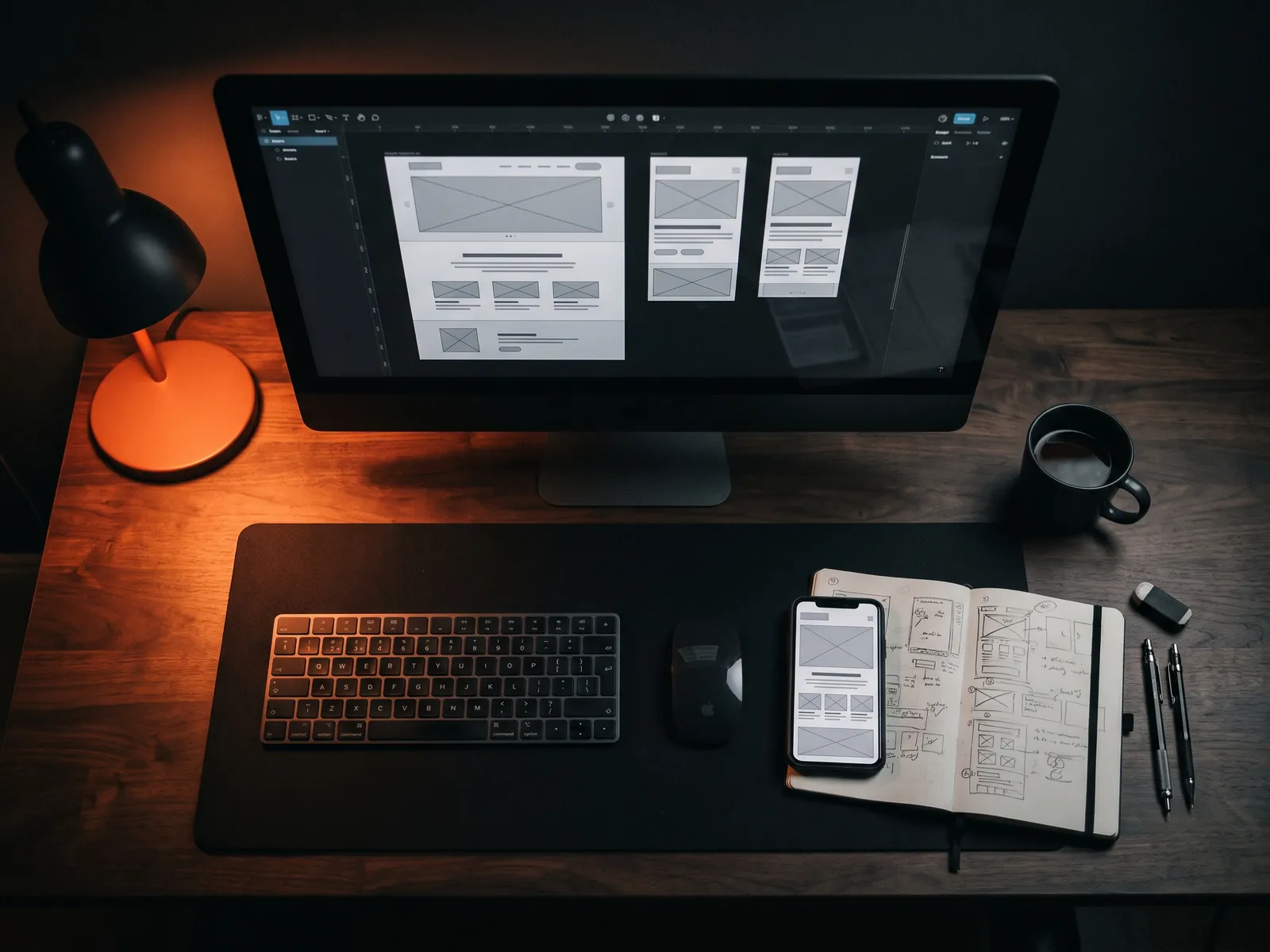
UX/UI design is deciding what goes where, and why, before anyone argues about colours. I look at how your customers decide, sketch the pages and forms in plain grey boxes, test them on a phone, and only then make them look good.
Free: a 30-minute call, an action plan and a price range in writing.
Poor UX rarely shows up as complaints. It shows up as silence.
Services hidden under vague labels like "Solutions", so visitors cannot find the one they came for.
Twelve fields, a CAPTCHA and an error message that wipes everything typed so far.
Tiny links, buttons too close together, text you have to pinch to read.
What people ask before they buy, gathered from you, your reviews, calls and competitors.
Which pages exist, what they are called and how they link, in customers' own words.
Grey-box layouts of key pages for mobile and desktop, so content is agreed before design.
Typography, colour, buttons and states built into a small, consistent system.
Booking, quote request, checkout or sign-up, mapped step by step and simplified.
Call with you, look at analytics, reviews and competitor sites.
Page list and navigation agreed in plain words.
Key pages and forms in grey boxes, tested on a phone.
Final look applied, three rounds of revisions.
Hand-coded or on a custom CMS, matching the design closely.
UX and interface design are part of every website I build. For advice on an existing project, book a consultation.
Research, wireframes, design and build in one project.
Complex flows, branches, catalogues or client areas.
A review call on your layouts or flows.
UX/UI design sounds like something only banks and app companies need. In practice, every small business website has a user experience, good or bad. When a customer cannot find your opening hours, gives up halfway through a booking form, or taps the wrong button because two are crammed together, that is a UX problem, and it costs you work.
For a small business, UX design is mostly common sense applied carefully: understanding what customers need to know before they act, putting that information in the order they need it, and removing every obstacle between interest and enquiry. UI design then makes the result clear, consistent and pleasant to look at.
Before I draw anything, I want to know how your customers make up their minds. What do they ask on the phone? What do your reviews praise or complain about? What do competitors show that you do not? A private physiotherapy clinic in Edinburgh, for example, might find that people care most about whether they need a GP referral, whether insurance is accepted and whether there is an evening slot. Those answers shape the homepage far more than any design trend.
If you want to dig deeper, customer research is a service in its own right, but for most websites an hour's conversation and a look at reviews is enough.
Wireframes are simple grey-box layouts that show what goes on each page and in what order, without colours or images to distract. They let you agree the content and structure quickly, and they make it cheap to change your mind. Moving a box in a wireframe takes a minute; redesigning a finished page takes days.
I always draw the mobile version first. Most local searches in the UK happen on phones, and a layout that works on a small screen will adapt easily to a large one. The opposite rarely works. The mobile website checklist lists what I check at this stage.
The most valuable UX work is often on forms and multi-step flows: booking an appointment, requesting a quote, checking out. Typical improvements include:
For businesses that take appointments, the booking flow matters more than any other page. The guide to online booking for service businesses compares the options.
Good UX and accessibility overlap heavily. Readable text sizes, sufficient colour contrast, large tap targets, clear labels and keyboard-friendly navigation help everyone, not only disabled visitors. I design to WCAG 2.2 AA, which is the usual benchmark in the UK for meeting Equality Act expectations. The website accessibility page explains more.
You do not need a usability lab to test a small website. Before build, I ask you and two or three people who match your customers to try the wireframes on their own phones: find a price, book a slot, send an enquiry. Where they hesitate is where the design needs work. After launch, analytics and recordings of anonymous sessions (with consent where the law requires it) show where real visitors drop off.
UX and UI design are part of every website I build, not a separate invoice. A business website starts at £850 and includes discovery, wireframes, design and build. Larger projects with complex flows, client areas or branches are built on a custom CMS from £3,350. If you only want a second opinion on an existing design, a consultation costs £25 an hour, and the first 30 minutes are free.
UX, user experience, is about whether people can do what they came for: find the service, understand the price, book the appointment. UI, user interface, is how it looks: type, colour, buttons, spacing. Good UI on bad UX is a beautiful maze. I do both, in that order.
They need the thinking, not a fifty-page report. For a small site, that means an hour understanding how customers decide, a clear page list, and wireframes of the pages that matter most. It is built into every website project with me rather than sold as a separate stage.
I do not work on top of other people's code. If the structure is sound, I can design a new interface and build a new site that keeps your domain and content. If you only want advice, a consultation at £25 an hour, with the first 30 minutes free, covers a review of your current layouts.
My focus is websites, booking flows, client areas and edit panels for small and medium businesses. For complex mobile apps, a specialist app studio is usually a better fit. If your app needs a marketing site, landing pages or a web-based booking system, that is squarely my work.
Describe your site or idea and what people struggle with. I reply within one working day.
What do you need most?